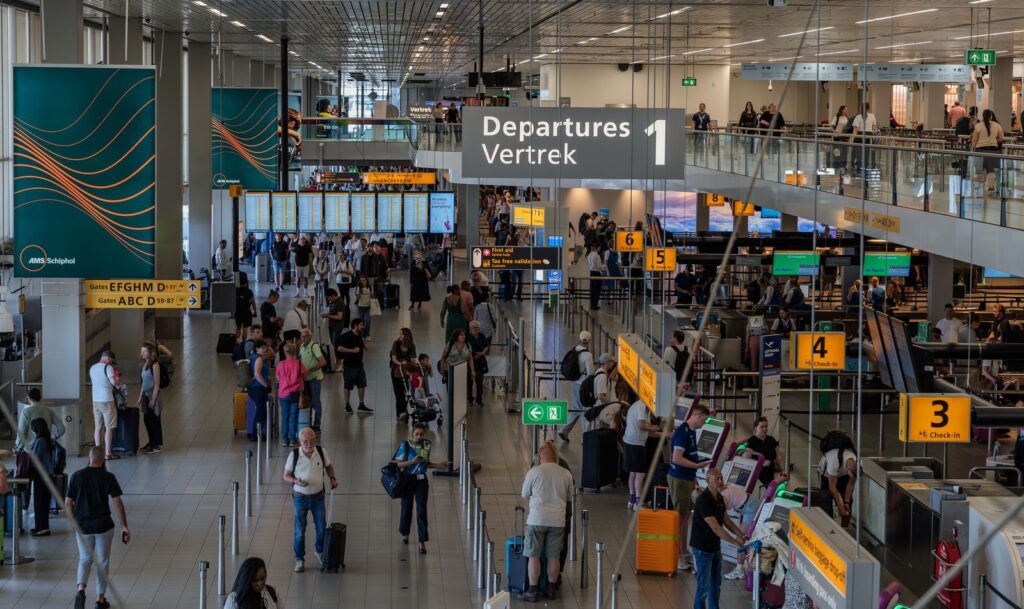
The Federal Aviation Administration ordered a halt to takeoffs nationwide on Friday afternoon, Nov. 13, and many travelers now hold tickets for flights that may not leave tonight. If yours is scrapped, the federal flight cancelled refund rule is the one protection that does not depend on who or what caused the disruption. This guide covers how that rule applies to the ground stop: what triggers it, who has to pay, and how the money comes back.
Where it stands: According to Clash Report, Advisory 111, titled “National Ground Stop” and posted just before 4 p.m. ET by the FAA’s command center, told operators that “All departing traffic should remain ground stopped until further notice.” As of 5 p.m. ET Friday, no official lift had been announced, and the outlet noted that “Neither Duffy nor the FAA gave a cause or said when departures would resume.”
Flight cancelled refund rules do not care about the cause
Many travelers assume that when the government grounds planes, the airline is off the hook. For the fare itself, that is not how the Department of Transportation reads its own rule. In the 2024 final rule that wrote automatic refunds into federal regulations, the Department said its policy on refunds for cancellations “applies irrespective of the reason for a cancellation, and this continues to be the case under this final rule.”
So a cancellation forced by an air traffic control failure is treated the same as one caused by a broken aircraft or a staffing gap. What changes with the cause is everything else: meals, hotels and goodwill gestures. Those are covered in our separate guide on whether airlines owe meals and a hotel after an FAA outage.
A ground stop by itself is not a cancellation
The refund obligation is triggered by what the airline does with your flight, not by the FAA order. USA Today, explaining the halt, put it plainly: “It does not necessarily mean all flights have been canceled.” Many flights held on the ground will simply leave late once departures restart, and the advisory’s own end time is soft. USA Today also noted that “The listed expiration time does not guarantee that flights will resume by then.”
Under 14 CFR Part 260, the fare becomes refundable in two situations: the airline cancels the flight, or it delays or changes the flight enough that federal rules call it a significant change. In either case, the refund is owed only if you decide not to travel on what the airline offers instead.
When a delay becomes a significant change
The thresholds are set out in the definitions section of Part 260. The Department explained in 2024 that it had “deemed that any change to these original times by three hours or more for domestic itineraries and six hours or more for international itineraries are material and significant to consumers.” The main triggers that matter after a nationwide stop are below.
| What the airline does | Fare refundable if you decline? |
|---|---|
| Cancels the flight | Yes |
| Domestic trip now arrives 3+ hours late | Yes |
| International trip now arrives 6+ hours late | Yes |
| Moves you to a different departure or arrival airport | Yes |
| Adds a connection you did not have | Yes |
| Short delay, under those limits | No, not under Part 260 |
| You accept the new flight or a voucher | No cash refund |
The regulation’s wording for the arrival test is that the traveler “is scheduled to arrive at the destination airport three or more hours for domestic itineraries or six or more hours for international itineraries after the original scheduled arrival time.” The clock runs from the time printed on your original booking.
Foreign airlines on US routes are covered
The rule is not limited to American carriers. Part 260 defines a covered carrier as “an air carrier or a foreign air carrier operating to, from, or within the United States, conducting scheduled passenger service.” A traveler holding a ticket from London, Mexico City or Kingston to a U.S. airport on a foreign airline therefore has the same federal refund right on that flight as someone flying a domestic route. Travelers departing from Europe may also have rights under European law, which a different guide covers.
The obligation sits with whoever took your money. Part 260 says “A covered carrier that is the merchant of record must provide a full and prompt refund of the airfare, including any taxes and ancillary fees.” If an online travel agency charged your card, the agency is the merchant of record and handles the refund, with the airline required to confirm eligibility to the agency without delay.
How the money comes back
The regulation leaves little room for airlines to stall or substitute:
- Same payment method. The refund “must be issued promptly in the original form of payment,” meaning the card, account or miles you used, unless you agree to a cash equivalent.
- Deadlines. Part 260 defines a prompt refund as “within 7 business days after the earliest date the refund was requested” for credit card purchases, and “within 20 calendar days after the earliest date the refund was requested” for cash, debit and other payments.
- No fee. “Carriers may not retain a processing fee for issuing refunds that are due.”
- Whole fare. Taxes and paid extras such as seat assignments and bag fees for the unused trip are included.
- Silence counts. If the airline offers a rebooking and you never answer, the rule still treats the refund as due once the offered flight leaves without you.
Airlines must also use their alert systems to tell travelers when they are owed money. The rule says covered carriers “must ensure that their passenger notification systems notify passengers owed a refund.” If an app message only offers a new flight, the refund option has not disappeared.
Vouchers and credits are optional
During mass disruptions, airlines often push travel credits first. Under Part 260, a voucher is only an alternative you can choose. The airline cannot treat you as having taken it “unless the consumer affirmatively agrees to the alternative form of compensation.” Any voucher offered in place of a refund must remain usable for at least five years, and the airline must state its restrictions up front.
If you clicked through an app screen quickly and are not sure what you accepted, check your booking record and the airline’s emails before you contact them. Our earlier explainer on airline refund rights when a flight is cancelled walks through the general rule in more detail.
What the refund rule does not give you
The refund puts your fare back. It is not compensation for the lost evening, a missed event or a nonrefundable hotel. There is no federal rule in the United States that pays cash for delays. The Department of Transportation had floated one, then reversed course: a Federal Register notice in November 2025 stated, “The Department is withdrawing the ANPRM on Airline Passenger Rights issued on December 11, 2024,” and concluded that “the statute does not authorize the Department to require reimbursements or compensations for flight disruptions.”
Waivers that let you change flights without a fare difference are a separate, voluntary airline policy. Latin Times reported on Friday afternoon that “rebooking waivers and rescheduling policies had not been formally announced at the time of publication.” A search of airline announcements by this site before publication found no ground-stop waiver either. If one appears, it adds options for people who still want to travel; it does not replace the refund rule for anyone whose flight is cancelled.
Frequently Asked Questions
Do I get a refund if my flight was cancelled because of the FAA ground stop?
Under the U.S. Department of Transportation refund rule, yes, if the airline cancelled the flight and you turn down the rebooking or any voucher it offers. The Department says the refund duty applies whatever the reason for the cancellation, so an FAA outage does not cancel your right to your money back.
How many hours late does a flight have to be for a refund?
The rule treats a change as significant when you would arrive three or more hours late on a domestic trip or six or more hours late on an international one. If you choose not to take that flight, the fare is refundable even on a nonrefundable ticket.
Does a foreign airline have to refund me for a flight to the US?
The rule covers foreign air carriers as well as U.S. airlines when they run scheduled flights to, from or within the United States, so a cancelled flight into New York on a foreign airline falls under the same refund requirement.
Can the airline give me a voucher instead of cash?
Only if you say yes to it. The airline can offer a credit or voucher as an alternative, but it must tell you that you have a right to a full refund, and the voucher must stay valid for at least five years.
Will I get extra compensation for the ground stop?
Not under federal law. The Department of Transportation withdrew its proposal on cash compensation for disruptions in November 2025, saying the statute does not let it require such payments.
Sources
- 14 CFR Part 260: Refunds for Airline Fare and Ancillary Service Fees — Electronic Code of Federal Regulations (U.S. Department of Transportation rule), current text, read November 13, 2026
- Refunds and Other Consumer Protections (final rule) — Federal Register (U.S. Department of Transportation), April 26, 2024
- Airline Passenger Rights; Withdrawal (ANPRM) — Federal Register via govinfo.gov (U.S. Department of Transportation), November 17, 2025
- FAA Nationwide Ground Stop Blamed on Air Traffic Control Comms Issue — Clash Report, November 13, 2026
- Ground stop live updates: FAA orders flights to remain grounded nationwide — USA Today (via Yahoo News), November 13, 2026
- Only the Third Time in U.S. History: FAA Halts All American Departures With No End Time. What We Know So Far — Latin Times, November 13, 2026
This article is general travel and consumer information, not legal advice. Passenger rights depend on where your flight departs, which airline operates it and that airline’s contract of carriage; check your airline and the regulator named above. Consumer Payouts reports what the sources listed above said on the dates shown, and facts in a developing story can change.